

In Kyengera town council on the outskirts of Kampala, Sarah Namukose had outgrown her small home-based business.
What started as a passion for processing dried fruits had slowly turned into a steady source of income. But growth came with new challenges. Her kitchen was no longer suitable for production, she lacked proper equipment, and meeting quality standards for larger markets felt out of reach.
Namukose’s story mirrors that of thousands of women entrepreneurs across Uganda—ambitious, resilient, but constrained by limited access to infrastructure, finance, and skills.
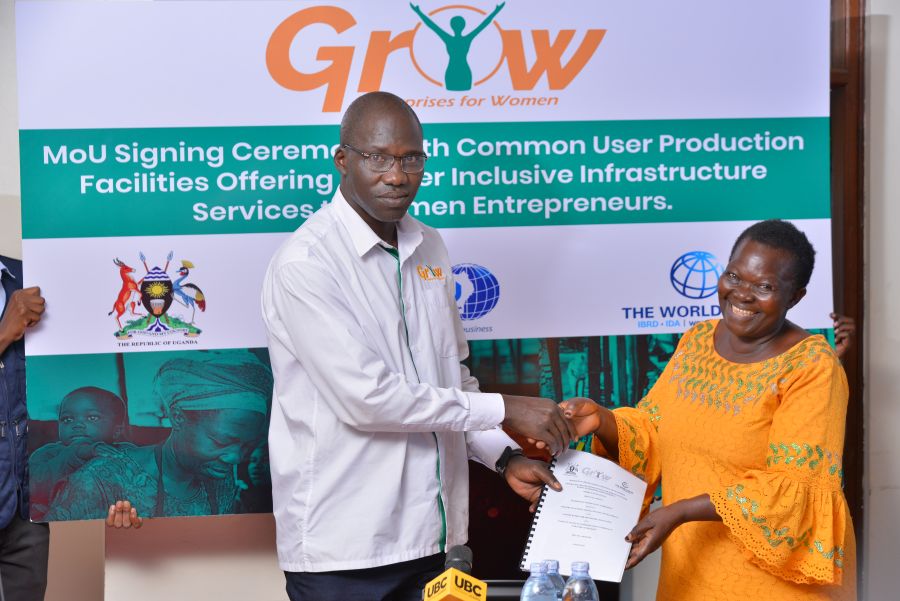
That is where the Ministry of Gender’s partnership with participating Common User Production Facilities under the Generating Growth Opportunities and Productivity for Women Enterprises (GROW) Project, begins to change the narrative.
These facilities are designed as shared production and value-addition hubs, giving women like Namukose access to modern equipment, safe working spaces, and processing support that would otherwise be too expensive to secure individually.
Instead of struggling alone, entrepreneurs can now produce at scale, improve product quality, and meet market standards within a supportive environment tailored to their needs.
For Namukose, stepping into one of these facilities meant more than just access to machines. It meant legitimacy. Her products could now be packaged professionally, certified, and supplied to larger buyers. The transition from informal production to structured enterprise suddenly became possible.
But infrastructure is only one piece of the puzzle.
Like many women, Namukose had long faced barriers in accessing finance. Without collateral or formal records, banks often turned her away. Through initiatives such as the GROW Project, she was able to access a small but affordable loan designed specifically for women entrepreneurs. That capital allowed her to purchase raw materials in bulk and stabilize her production cycle.
At the same time, she enrolled in business training sessions offered alongside the financing. She learned how to keep proper records, price her products competitively, and plan for growth. She also gained confidence—an often overlooked but critical ingredient in entrepreneurship.
With both skills and financing in place, she began to think differently. She was no longer just producing to survive; she was building a business. She experimented with new packaging, explored digital marketing, and started supplying to retailers beyond her immediate community.
The combination of shared production facilities, access to finance, and practical skills training created a powerful shift. Each element reinforced the other. The facility gave her the tools, the financing gave her the means, and the training gave her the knowledge to use both effectively.
As her business grew, so did its impact. She hired two additional workers from her community. Her household income improved, allowing her to support her children’s education and invest back into her enterprise.
Across the country, similar stories are beginning to unfold.
Common User Production Facilities are not just buildings filled with equipment—they are enablers of transformation. They address the everyday barriers that have long held women entrepreneurs back, from lack of space and machinery to limited access to markets and finance.
And as more women like Namukose move from subsistence to scale, the ripple effects extend far beyond individual businesses. Communities benefit from job creation, households become more stable, and the broader economy becomes more inclusive and resilient.
In the end, it is not just about supporting women to start businesses. It is about creating the conditions for them to grow, compete, and lead.
